
As we explored in a previous article (here), AI can be manipulated into becoming the ultimate “yes-man,” mindlessly confirming every aspect of what we want without challenging our thought process. It is crucial, therefore, to understand how to avoid these pitfalls and utilize this technology correctly.
One approach is to ask AI itself how to prevent this. For instance, after receiving an answer tour previous prompt, I followed up with:
“Would you mind expanding a bit more on your points on how to mitigate the risk of AI echo chambers?”
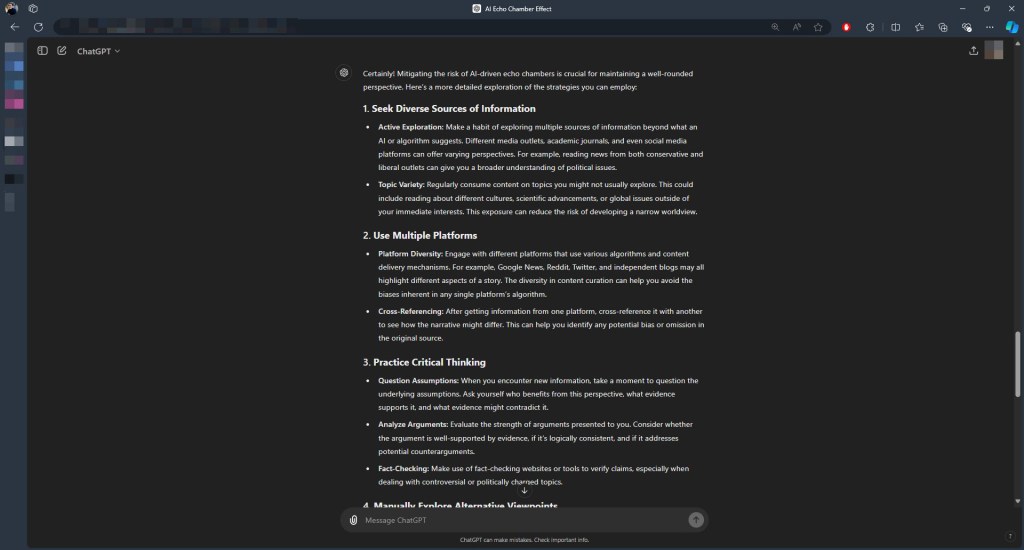
Figure: Answer by OpenAI’s ChatGPT
When we do this, we often receive valuable suggestions worth considering. It’s remarkable how consistent the advice can be, even with slight variations in phrasing.
- Diversify your sources
The first and most essential step is ensuring your information doesn’t come from a single source. A plurality of opinions provides a robust defense against echo chambers. Disagreement, in fact, offers a valuable opportunity to explore perspectives you may not have considered.
- Try different platforms
While most AI models share similarities, occasionally using different platforms can help you verify the accuracy of the information you receive. It serves as a useful cross-check, enabling you to compare various options.
- Think critically
Challenging assumptions, weighing different arguments, and fact-checking are vital to ensure the information you’re considering is accurate or, at the very least, not misleading. Remember, objective truth is elusive in human relationships and should never be taken for granted.

Figure: Answer by Anthropic’s Claude
- Utilize manual methods
AI has undoubtedly simplified information gathering and streamlined research processes. However, sometimes referring to traditional methods—like search engines or printed books and newspapers—can serve as a valuable counterbalance to the information you receive from AI platforms.
- Remember that you can be biased
Confirmation bias is the psychological tendency to seek validation from our tools and sources. Being aware of this pitfall helps you filter information more accurately and prepare for a more balanced understanding.
- Prompt differently
As you become more adept with AI, you may fall into consistent patterns of writing and expression. Varying how you formulate questions can help challenge the results you receive. Remember also to avoid assuming your viewpoint is complete; instead, ask for opposing perspectives to broaden your understanding.
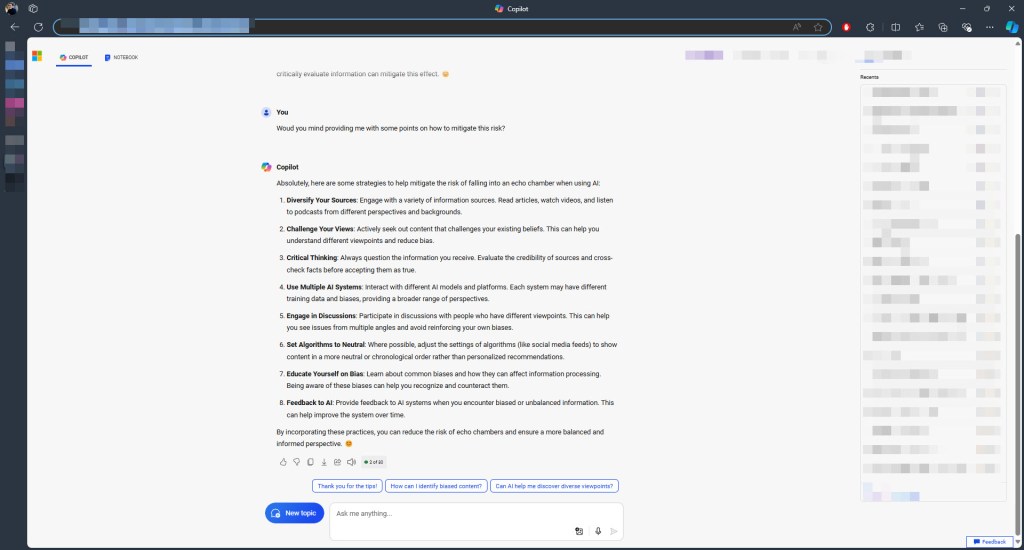
Figure: Answer by Microsoft’s Co-Pilot
- Reflect
Regularly revisit your thought processes and assumptions on particular topics. Identify any changes or new elements and consider whether adjustments are necessary.
In the end, overcoming AI echo chambers depends on our ability to recognize when we might be wrong and remain open to new ideas. A positive, growth-oriented mindset sees differing opinions not as threats but as opportunities to learn and improve, ultimately optimizing AI as a valuable tool.




 _BlnkTerminal
Share what you think!