
In Dialogic Education and Technology, Wegerif postulates that we have enough evidence to suggest that the gathering of people into groups does not happen as a consequence of technological development, but rather the other way around.
If we take this idea as a starting point, we might better understand the various challenges that students in online environments face today, as well as those that will arise in the future. This is primarily because we could argue that, as a collective, we have not yet sufficiently gathered around digital mediums—a situation likely to change with generational replacement.
Currently, however, the issue could be described as a lack of proper digital infrastructure that enables the broadest spectrum of society to participate. We cannot dismiss written text as a form of interaction when considering the remarkable success of the various AI platforms in recent years. If anything, texting and written mediums appear to be of particular interest to this generation.
We can only speculate that as we complete the curve of technology adoption for videogames and VR systems, we might experience a full systemic change. This change would be driven by digital natives who are well-versed in navigating digital technologies and will naturally gravitate toward more digital alternatives.
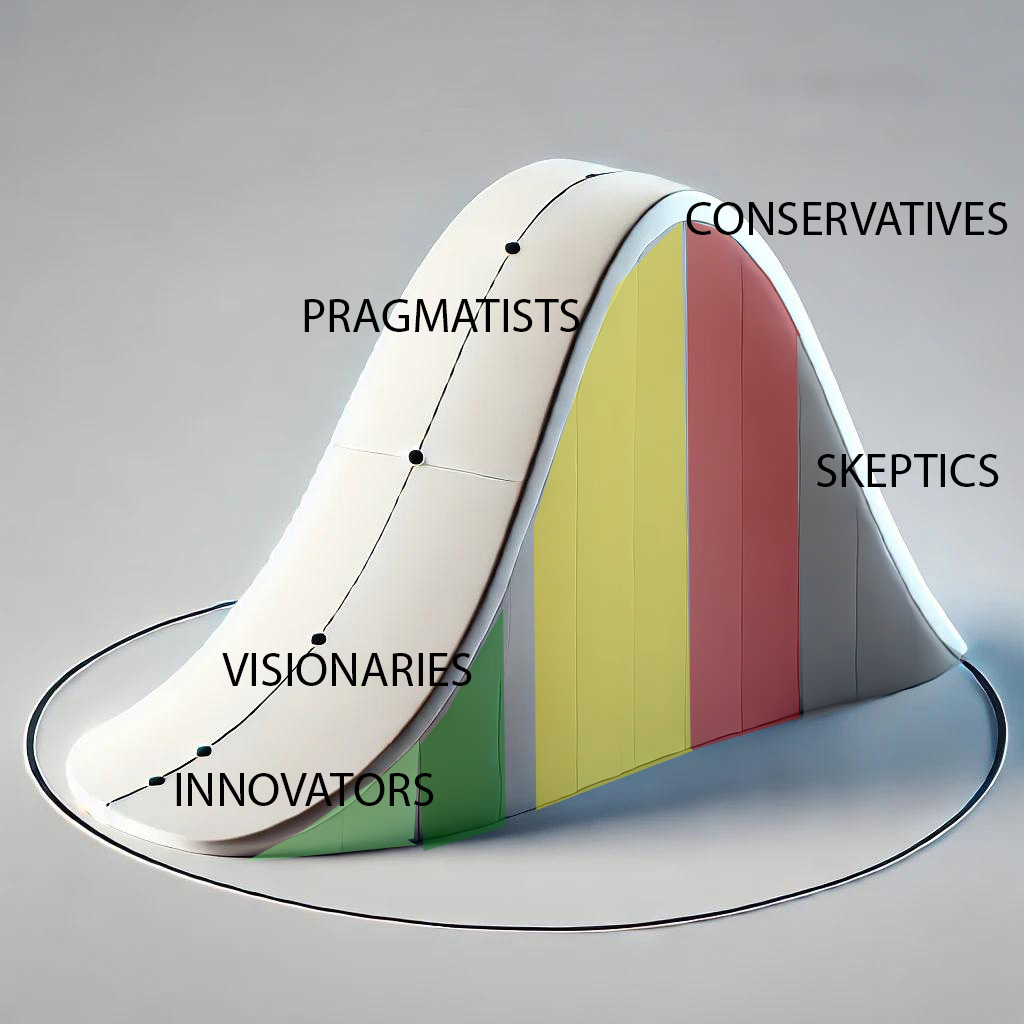
Figure: The curve of technology adaptation. Created with ChatGPT using DALL-E3. Simplified model.
That said, our educational models, already outdated and under stress due to the shifts in the cultural and productive landscape of society—as Bauman exposed in Liquid Modernity—are now tasked with measuring new patterns of communication and behavior using tools that are not suited for the job.
It’s not that the fundamental psychology of knowledge construction and approaches to learning have changed, but rather that interactions now occur at different paces and within contexts where time and space hold new meanings.
For example, consider a forum conversation as a case study. The dialogue facilitated by such means transcends time, as individuals have hours or even days to participate. Until now, books have been the closest analogy, allowing a space of months or even years for engagement. We are, therefore, moving into an entirely different scale.
The challenge, then, lies in identifying the right metrics to define this new space, where all kinds of interactions are happening at different times, through varying interpretations and forms. Perhaps Fish was correct in Is There a Text in This Class? when he argued that what we are witnessing is simply the integration and attempted discussion of different collectives and communities that inherently carry different meanings.
An image comes to mind, not unlike the Dark Forest theory: two completely different individuals, generations, and community members facing each other in a brand-new space where ideas are bound to collide. This might just be the largest communication experiment of our era.




 _BlnkTerminal
Share what you think!