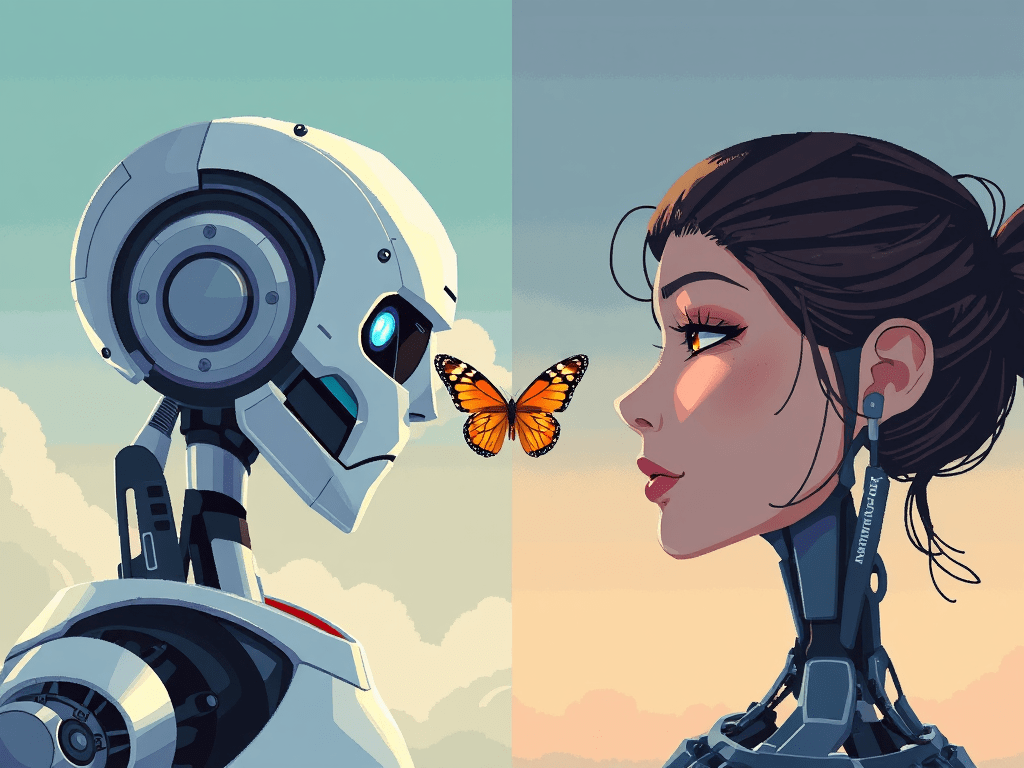
It’s rather paradoxical that the closer we believe we are to achieving AGI (Artificial General Intelligence), the further we actually seem to be. Nature, after all, has solved incredibly complex problems through elegant designs—often developed in entirely unrelated evolutionary contexts. Just think of how an eye works: a biological solution to a physical and perceptual challenge that no lab has truly replicated. And one solution that spans multiple species sometimes not even related to one another.
And yet, even our most powerful systems struggle to match a fraction of what living beings do effortlessly.
Ironically, the tasks that are nearly impossible for machines—like perception, physical balance, or intuitive decision-making—come naturally to humans and animals. On the flip side, things we find incredibly hard—like solving vast equations or processing gigabytes of raw data—are trivial for machines. This disconnect is what we call the Moravec Paradox, a reminder of just how difficult and mysterious life is at its core.
It’s a humbling thought—one that confronts us with how little we truly understand life and its elegant workarounds. One can’t help but wonder: what lies at the core of this seemingly aimless pursuit? Why are we so obsessed with building machines that appear “human”?
At times, it feels like a relentless—and perhaps futile—assault on divinity itself. A kind of modern-day celestial rebellion, where we attempt to replace the very forces of nature that made us possible in the first place. In contrast, disciplines like biomimicry offer a wiser path: one that sees nature not as a competitor to surpass, but as a teacher to learn from. They invite us to recognize the genius embedded in natural systems—and to draw inspiration, not opposition, from them.
It’s as if Pinocchio, having finally been granted personhood, decided to devote himself to building tools better than Geppetto. It’s nonsense. Utterly misguided. We’ve funneled immeasurable resources into trying to replace our finest qualities, when the real task should be learning how to use them in service of others—and to solve the problems that still define our time.
We’re living in strange times, no doubt. But perhaps the most profound—and damaging—shift we’re experiencing is our growing disconnection from ourselves. Human achievement is beginning to feel less inspiring than the cold output of machines.
While I fully understand the value of amplifying our productivity through tools, that pursuit still demands clarity: What vision of ourselves are we serving with all this advancement?
When we begin seeking replacements for our highest aspirations—rather than expressions of them—it becomes a sobering thought. No matter how hard we try, we keep getting thrown back down to the cold floor of reality whenever we attempt to play gods.
Even more sobering is the reason behind this pursuit. We want machines that can produce endlessly—driven by an economic ambition that is no longer tied to improving life for all, but instead in service of blind, unreachable greed.
Perhaps it’s time to pause, look back, and ask ourselves: Where are we going—and why?





Share what you think!