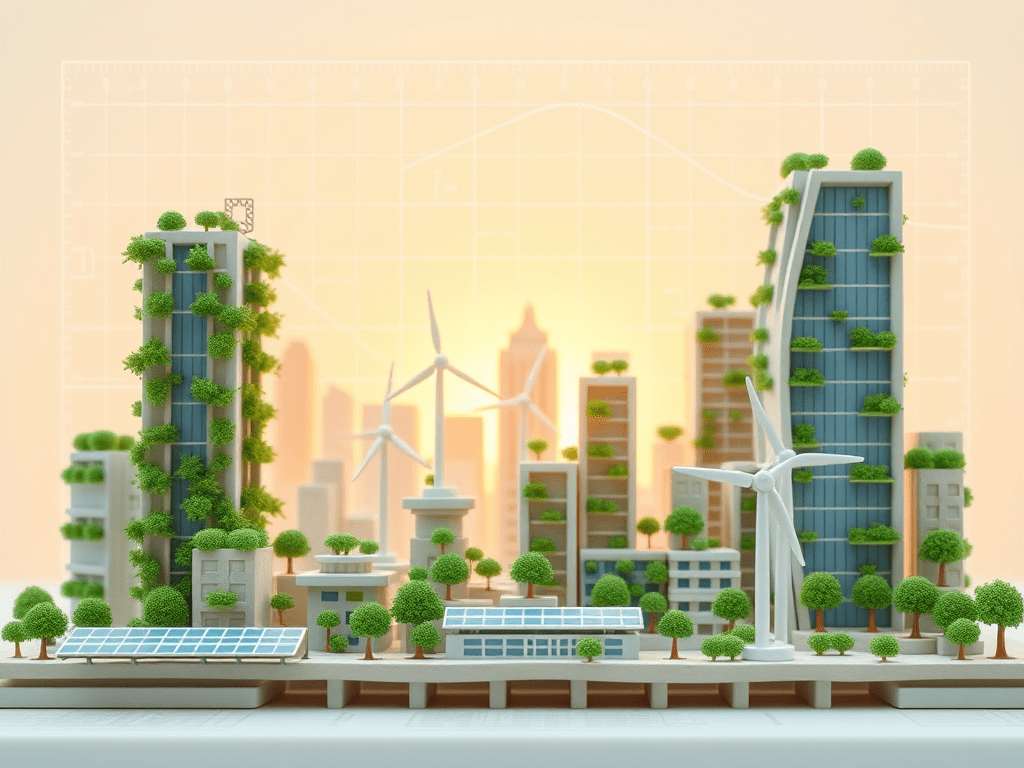
One common topic often discussed is the impact that built infrastructure has on the environment and the different ways in which this can be mitigated.
This is a multi-faceted and complex issue; part of the problem is linked to existing production methodologies, which have yet to be replaced by more sustainable approaches that consciously integrate with the broader ecosphere.
The other side of the equation is the incomplete adoption of advanced design techniques that could more fully embody these sustainable principles. It’s here that we encounter BIM—and the suite of technologies orbiting around it.
In this sphere, and in a world increasingly driven by information, it seems almost paradoxical that we still haven’t found a reliable way to harness data to build truly greener infrastructure.
While it’s true that we’re advancing by leaps and bounds, we also belong to a generation of practitioners that appears to have grown disenchanted with the actionable side of our profession.
Architecture undoubtedly remains a creative endeavor. But somewhere along the way, creativity has drifted from its rightful place—interpreting innovative ways to adapt to constraints—into a quest to produce ever more sculpturally impressive statements. This shift not only breaks the essential purpose of providing functional habitat but also squanders precious resources on pursuits that, ultimately, are little more than vanity.
We can arguably trace both of these issues to the disconnect between an ever-shrinking middle class—who historically held the means to realize construction as a tangible act—and the relentless rise of living costs and inflation. Basically, no money means no construction.
One of the main issues with this disrupted chain is that construction, as a trade, is effectively an effort multiplier—it weaves together supply chains and stimulates local economies well beyond the narrow facade of expertise alone.
One solution that could help us bridge this gap is certainly the use of BIM technologies and systems. And by this, I don’t just mean powerful software suites—I mean the underlying classification systems that allow us to capture and organize more meaningful information.
True, not every country has institutions as well-supported as Norway’s Statsbygg. But in places where strong governance structures can’t step in, it should be only natural for private-public partnerships to lead the way.
A push toward further standardization and more complete systems may be the only way our various social groups can stay genuinely informed about the carbon inventories and resource flows within their territories. But this must be coupled with a healthier vision of planning agencies: seeing them not as bureaucratic hurdles to one of our most profitable industries, but as investments in society’s broader long-term health.
Tightening standardization from this point on could help us create new chains of value—allowing us to compare data in similar formats, even when it’s produced in entirely local contexts. Ultimately, this could all be woven together through AI-driven prognoses and projections.
Unfortunately, such a scenario feels unlikely at the moment, given the sweeping instability of global systems.
Still, even if it’s not feasible to think in fully global terms right now, we carry a moral responsibility to explore these ideas at least on a regional scale. By developing these systems locally, we pave the way for solutions that can later be exported, contributing to a genuinely greener world.



 _BlnkTerminal
Share what you think!